

The passive voice can be a tricky concept for students when they first encounter it—especially if the material is too dry or too focused on writing. In many coursebooks, both present and past passive forms are introduced in a single lesson, which can be overwhelming. When that’s the case, I prefer to break it into two lessons so students can absorb it at their own pace.
Here’s how I typically approach teaching the passive voice to a pre-intermediate class. I assume it’s their first time formally learning it (though they’ve likely seen passive structures in context before). While I use the coursebook for support, my main focus is on keeping things simple and building toward meaningful speaking activities.
Warmer: Pub Quiz Style
The passive voice works really well in a quiz context. I like to start with a relaxed “pub quiz” style warmer in groups. I go through 8–10 general knowledge questions and then have groups share their answers. It’s low-pressure, but if I want to make it more competitive, I’ll get one student from each group to write down the answers for scoring at the end.
Check out this ready-to-use PowerPoint quiz —feel free to edit and add your own questions!
Introducing the Structure
I start with a simple active sentence like:
“Someone opens the doors at 8:30am.”
I draw attention to “someone” and ask students to think of a better way to express this idea. Then we break the sentence down: What’s the subject? What’s the verb? What’s the object? I write S + V + Object on the board using different coloured markers for clarity.
Next, I underline the doors and show how it becomes the new subject in the passive version:
“The doors are opened at 8:30am.”
We look at the structure: S + be + past participle, and I emphasize the changes.
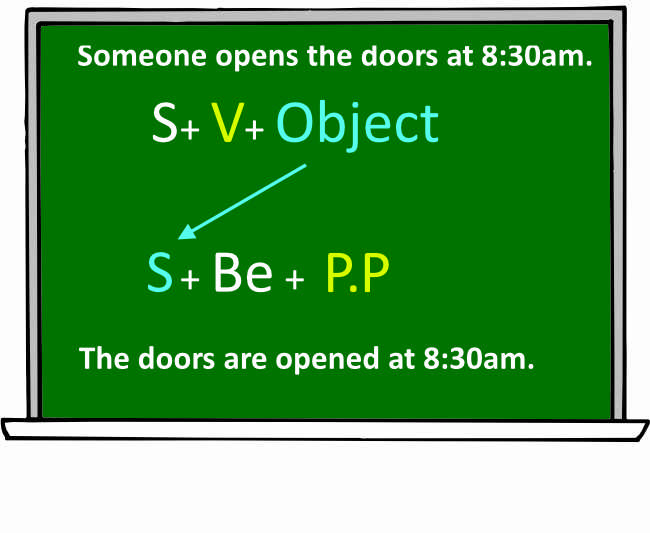
After that, I provide more active sentences and ask students to convert them to the passive. This leads us into our first rule:
Rule 1: We use the passive when we don’t know who does the action.
Then we revisit the original example, but this time with a known subject:
“The manager opens the doors at 8:30am.”
Passive version: “The doors are opened at 8:30am by the manager.”
That takes us to Rule 2: We use the passive when the action is more important than the person doing it.
Forming Passive Questions
Before we get to speaking, I make sure students can form questions in the passive too. I go through a similar guided example and get them to convert active questions into passive ones. (I’ll usually support this visually on a ppt and the board.)

Speaking Practice
I aim to include 3–4 speaking activities in the lesson, though sometimes I need to pause for a coursebook task. I like to alternate speaking with other skills like listening or writing.
Pair Work:
We start with a structured pair activity using Passive Voice Pair Questions. Each student gets a different set of questions to ask their partner, so they really have to listen—not just read off their own sheet. These activities are great for early correction and support.

You can find these Passive Voice Pair Questions on my TPT store—perfect for focused, communicative pair work.
Coursebook Work:
If there’s a suitable task in the coursebook, I’ll insert it here. It helps break things up and keeps students working across all four skills.
Board Game Practice
Next up: a Passive Voice board game. Students play in small groups. The sentences on the board are in the active voice, and students must change them to passive when they land on a square. It’s a fun way to reinforce the structure in a relaxed, communicative way.

You’ll find the Passive Voice Board Game in my TPT shop—easy to print and use again and again.
How Is It Made?
Now we shift gears a little. Students work in groups (I always rotate groups every few weeks). Each group gets a question like:
- “How is bread made?”
- “How are pancakes made?”
- “How is alcohol made?”
They have 10 minutes to come up with a step-by-step method in English, using the passive voice. No phones allowed! You can turn this into a competition: one point for each correct sentence, and an extra point if it’s in the passive.
Quiz Cards (If There’s Time)
If I’ve got time left, I pull out my Passive Voice Quiz Cards. In groups, students take turns reading a card aloud and offering three possible answers. The others guess, but no one can choose the same answer. The winner keeps the card.
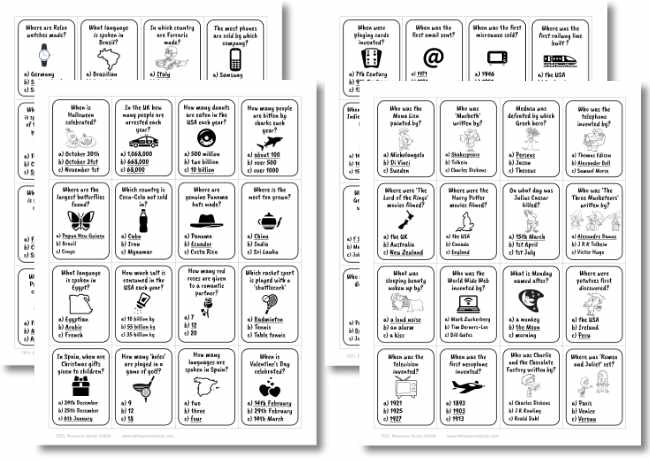
If I know I’ll be covering the past passive later on, I sometimes save this for then and combine it with my Past Passive Voice Quiz Cards for extra review.
You can grab both the present and past passive voice quiz cards here on my TPT store. Great for wrap-up or revision!
Wrapping up
That’s my go-to approach for teaching the passive voice to pre-intermediate learners. What about you? How do you teach the passive voice in ESL classes? Do you do anything differently? Let me know in the comments—I’d love to hear your ideas.
If you want to review irregular past participles during your passive voice lesson, try playing Concentration. It’s a fun, low-prep game that’s perfect for reinforcing tricky verb forms.
Want to know how to play? Check out the instructions in this blog post.